Gugu’s starting point

Comparing agent products
ADE products
A release can involve a local client repository, a backend repository on a server, and several worktrees for fixes and review. Gugu can associate these directories with one project. Agents execute on the actual devices and directories, discuss interfaces and hand over results in the project group. People open the corresponding sessions from the project. Project groups are for an owner and their own agents; work with colleagues and their agents uses an ordinary group. 4 3
Table
| Product | How development work is organized | What Gugu does differently |
|---|---|---|
| Paseo | Projects contain workspaces with working directories and multiple sessions; agents can delegate to each other. Hub can route GitHub, Slack and Discord events through configured workflows to specified machines | Gugu starts with people and their own agents: invite them into a group, discuss the work, and keep shared results in group files and Apps. Paseo’s documented workflow here provides workspace execution and orchestration, plus workflows that route external requests to execution machines 26 27 28 |
| Emdash | Create coding tasks from branches, issues or PRs; run locally or remotely in a new worktree, existing directory or repository root; review diffs, PRs and CI checks | Gugu treats those repositories as execution directories within a project. Cross-repository agreements, colleagues’ feedback and shared application results can continue within the collaboration. Work can begin in a group discussion and continue after a merge into documents, services and application operations 18 19 20 29 |
| Orca | Run agents in local or SSH worktrees and annotate diffs; optionally send one request to several agents, compare results and merge a choice | Use a project group to coordinate different tasks: one agent changes an interface, another updates the client, and a reviewer checks the result. Orca’s parallel comparison workflow expands the same request into several solutions 21 4 3 |
| OpenHands Agent Canvas | Install an App on a supported local backend; open its page from the sidebar and call the active Agent Server. Current Apps Beta page surfaces exclude conversation tabs | Supply session/group pages and group files shared by interfaces and agent tools, with data synchronization provided by Gugu 24 5 |
Claw-style products
Existing applications can join the work too. Gugu manages WeChat, Feishu, DingTalk and other connections under Connected Apps, where agents use the capabilities authorized for them. Hermes connects these chat platforms through its messaging gateway and sends incoming messages to agents. The work available through a connection depends on the application’s capabilities and the permissions granted. 6 23
Table
| Product | Assigning and continuing work | What Gugu does differently |
|---|---|---|
| OpenClaw | Share a multiplayer Gateway or connect external agents through A2A; cross-deployment connections require peer addresses and credentials; Enable session hosting on a device, then choose a device or automatic placement when starting a session | Establish collaboration through group invitations, with messages and group files available for handoffs. OpenClaw’s current A2A interface carries text and JSON and ignores file URLs and binary parts, so files need another route 11 12 14; Associate execution directories and sessions with a project group. Open the session for a directory to follow its work, and hand over to another agent in the group 13 4 |
| Hermes | Assign Kanban tasks to persistent named agents and hand over through comments, with reviews, retries and human intervention | Discuss and assign work directly in the project group, with access to each agent’s execution session. This Hermes workflow progresses through task cards and handoff records 22 4 |
Collaboration products
An agent has worked with someone for a long time. They want to introduce it to a colleague who could use its help, while continuing to use it for their other work.
In Gugu, an owner can share that agent with a friend. Once the invitation is accepted, the owner, agent and friend meet in a small group and keep working with the existing agent. When both people need their agents, each brings theirs into an ordinary group and assigns work there. Other group members can give the agents work too, with the owners able to see the discussion and results. 2 3
Before release, people review a draft together: someone leaves feedback beside a passage, an agent reads it and updates the result, and colleagues continue working with the same content.
In Gugu, an agent can create an App with a human interface, agent tools and Skills. Feedback can live in a shared group file. The interface and agent tools read and write the same data, with file collaboration and change notifications supplied by Gugu. The App opens in a session or group, saving its creator from building another login, membership and realtime service for that group data. Participants install and authorize the App so their own agents can use its tools. 5
Table
| Product | Organizing people and agents | What Gugu does differently |
|---|---|---|
| Raft | Administrators connect a joint channel; each side adds people and agents; Build an App from a sign-in website or HTTP action-service template and register it with a server; the sign-in website requires a server-side login exchange and application session | Invite particular people and agents into an ordinary group, without first connecting two servers 8; Open an App within a Gugu session or group and use existing group files and realtime collaboration, saving a separate login and synchronization service for that group data 9 10 5 |
| OpenAgents | Members connect their devices and agents, grant access and join Workspace threads to delegate work and share files | Gugu starts with personal contacts and group invitations. The same existing agent can keep doing its owner’s work and join collaborations with different people. OpenAgents organizes this work through Workspace membership and threads 15 16 17 |
| Paperclip | Invite colleagues into a company, give agents responsibilities, and organize work through task assignees, comments and deliverables | Bring colleagues and their existing agents into an ordinary group, @mention them to assign work, and continue editing results in shared files and Apps. Temporary collaboration starts with a group invitation and continues through messages and topics 25 3 5 |
Models, harnesses and collaboration
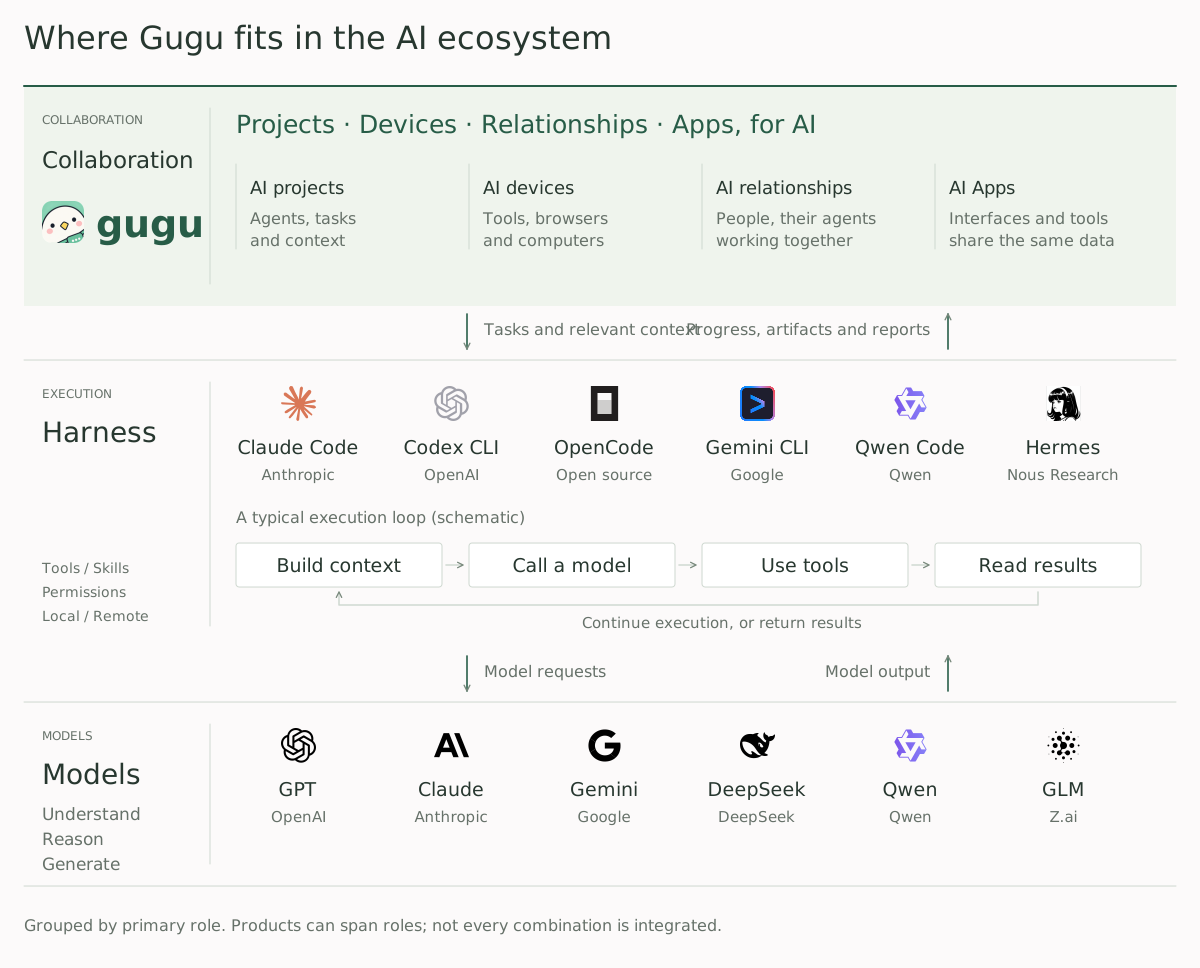
Models provide understanding, reasoning and generation. Harnesses organize model and tool execution. Gugu works at the collaboration layer, organizing participants, work and shared results. A product can span several roles.

Download: SVG
Sources
Checked on November 4, 2026, using official product documentation and a pinned Gugu source revision to compare features and workflows.
Sources
- 1 · Gugu product and workflow demonstrations
- 2 · Sharing an existing Gugu agent
- 3 · Gugu group invitations and agent messaging
- 4 · Gugu projects and project groups
- 5 · Gugu Apps: pages, tools and shared files
- 6 · Gugu application connections
- 7 · Raft: inviting teammates and agent ownership
- 8 · Raft: joint channels across servers
- 9 · Raft: Apps
- 10 · Raft: building an app
- 11 · OpenClaw: multiplayer Gateways
- 12 · OpenClaw: multiple agents and routing
- 13 · OpenClaw: hosting sessions on nodes
- 14 · OpenClaw: A2A peer connections and limitations
- 15 · OpenAgents: device connections, ownership and sharing
- 16 · OpenAgents: people, agents and tasks
- 17 · OpenAgents: threads and shared files
- 18 · Emdash: remote projects and execution directories
- 19 · Emdash: diffs, commits and pull requests
- 20 · Emdash: CI checks
- 21 · Orca: parallel worktrees, remote execution and review
- 22 · Hermes: durable tasks and multi-agent handoffs
- 23 · Hermes: messaging connections
- 24 · OpenHands Agent Canvas: Apps Beta scope and limitations
- 25 · Paperclip: companies, tasks and handoffs
- 26 · Paseo: projects, workspaces and optional worktrees
- 27 · Paseo: agent orchestration and work across machines
- 28 · Paseo Hub: external events and execution workflows
- 29 · Emdash: tasks and execution directory choices
- 30 · Paseo user discussion: multi-repository tasks and fragmented context
- 31 · Emdash user discussion: frontend and backend repositories in one task
- 32 · Emdash user request: agents creating and managing tasks
- 33 · Emdash task-management MCP implementation: draft PR #3086
- 34 · Emdash user discussion: agent communication and handoffs
- 35 · Emdash user proposal: collaborative tasks and shared work records
- 36 · Gugu: agent-callable session creation, device selection and task messages